Models of Bonding and Structure化学键与结构模型
Ionic lattices, covalent molecules, metallic seas of electrons, and everything in between. This unit explains why substances have the properties they do — from melting points to conductivity to solubility — by connecting structure to bonding.离子晶格(lattice)、共价分子(covalent bond)、金属"电子海"(metallic bond),以及介于它们之间的各种情况。本单元通过把结构与化学键联系起来,解释物质的熔点、导电性、溶解度等性质从何而来。
The Ionic Model离子模型
- State the ionic model: electrostatic attraction between oppositely charged ions in a lattice.
- Deduce the formula of an ionic compound from the charges of its ions.
- Explain why ionic solids are brittle, have high melting points and conduct only when molten or dissolved.
- Compare lattice enthalpies using ion charge and ionic radius.
- Calculate amounts of ions in a given amount of an ionic compound.
- 说出(
state)离子模型:晶格中带相反电荷的离子之间的静电吸引。 - 推断(
deduce):由离子电荷写出离子化合物的化学式。 - 解释(
explain)离子固体为何质脆、熔点高、仅在熔融或溶解时导电。 - 比较(
compare):用离子电荷和离子半径比较晶格焓。 - 计算(
calculate)给定物质的量的离子化合物中离子的物质的量。
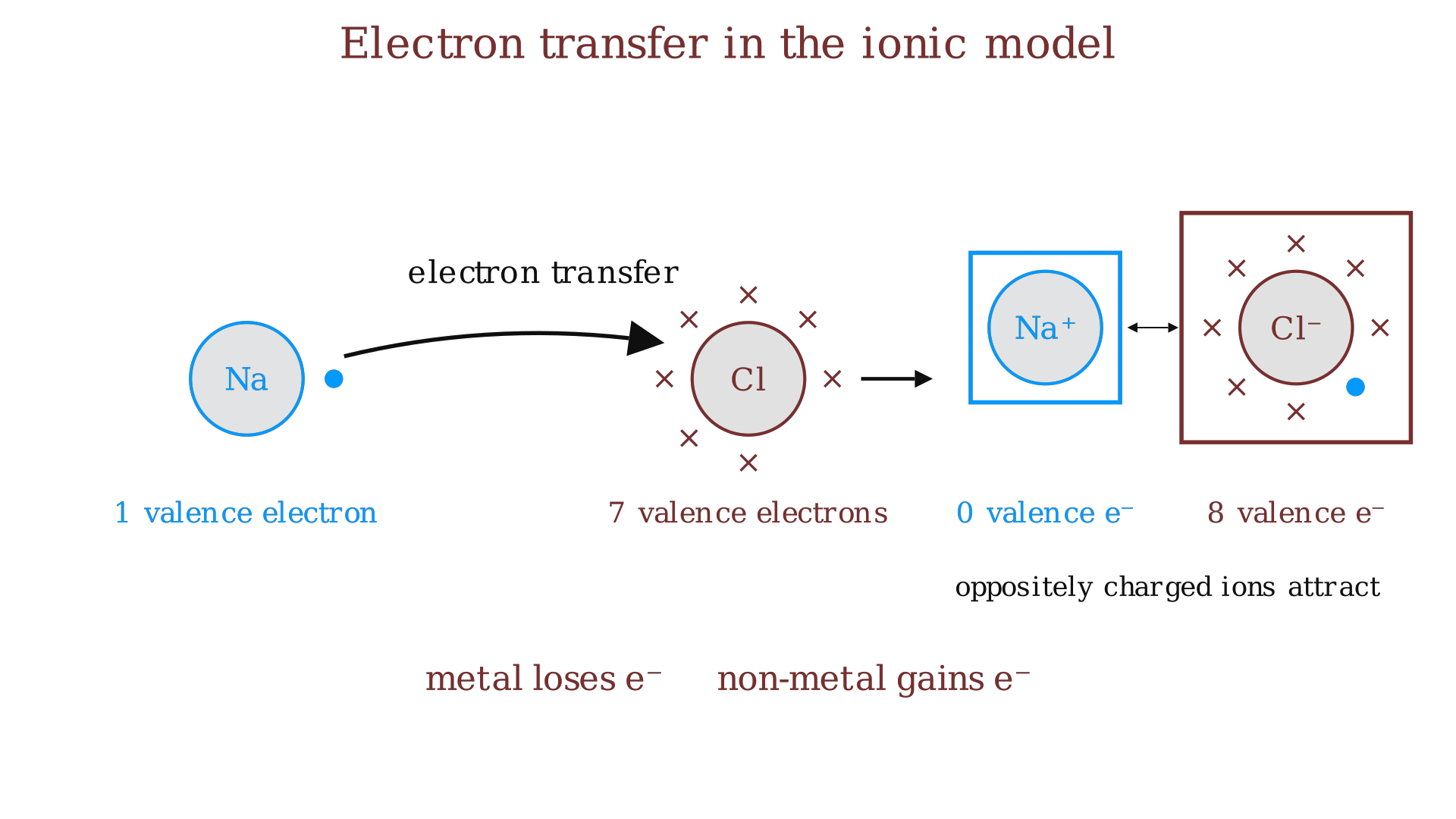
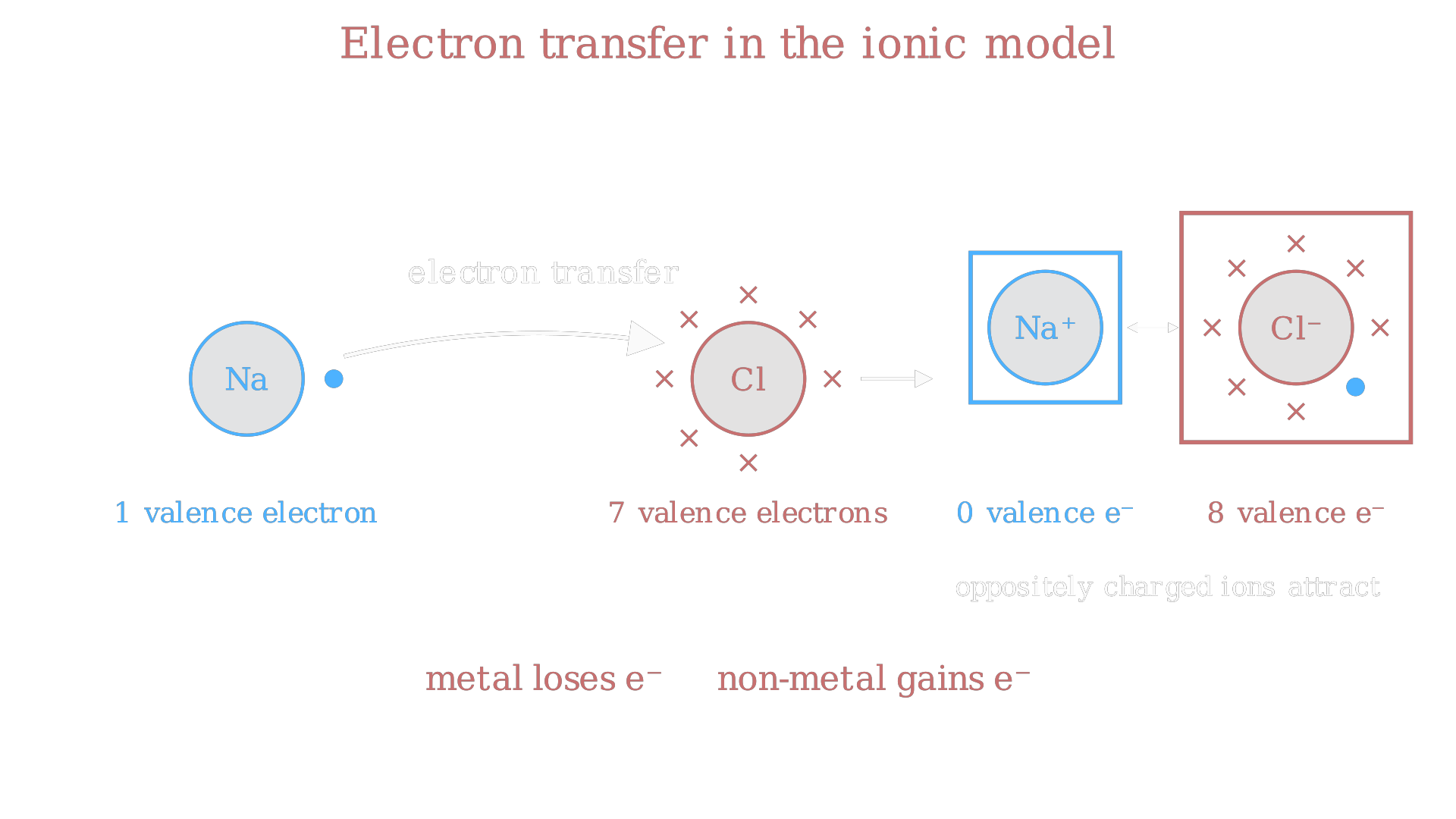
Ionic bonding occurs between metals and non-metals. Metal atoms lose electrons to form cations (positive ions); non-metal atoms gain electrons to form anions (negative ions). The ionic bond is the electrostatic attraction between these oppositely charged ions.
离子键(ionic bond)发生在金属与非金属之间。金属原子失去电子形成阳离子(cation,带正电的离子);非金属原子得到电子形成阴离子(anion,带负电的离子)。离子键就是这两种带相反电荷的离子之间的静电吸引。
Naming and Formulas命名与化学式
Binary ionic compounds are named with the cation first, then the anion with the suffix "-ide" (e.g., sodium chloride). For compounds containing polyatomic ions, you must know these by name and formula: ammonium (NH$_4^+$), hydroxide (OH$^-$), nitrate (NO$_3^-$), hydrogencarbonate (HCO$_3^-$), carbonate (CO$_3^{2-}$), sulfate (SO$_4^{2-}$), phosphate (PO$_4^{3-}$).
二元离子化合物的英文命名:先阳离子,后阴离子加 "-ide" 后缀(如 sodium chloride 氯化钠)。含多原子离子(polyatomic ion)的化合物必须记住下列名称与化学式:ammonium(铵 NH$_4^+$)、hydroxide(氢氧根 OH$^-$)、nitrate(硝酸根 NO$_3^-$)、hydrogencarbonate(碳酸氢根 HCO$_3^-$)、carbonate(碳酸根 CO$_3^{2-}$)、sulfate(硫酸根 SO$_4^{2-}$)、phosphate(磷酸根 PO$_4^{3-}$)。
Ionic Lattice Structures and Properties离子晶格结构与性质
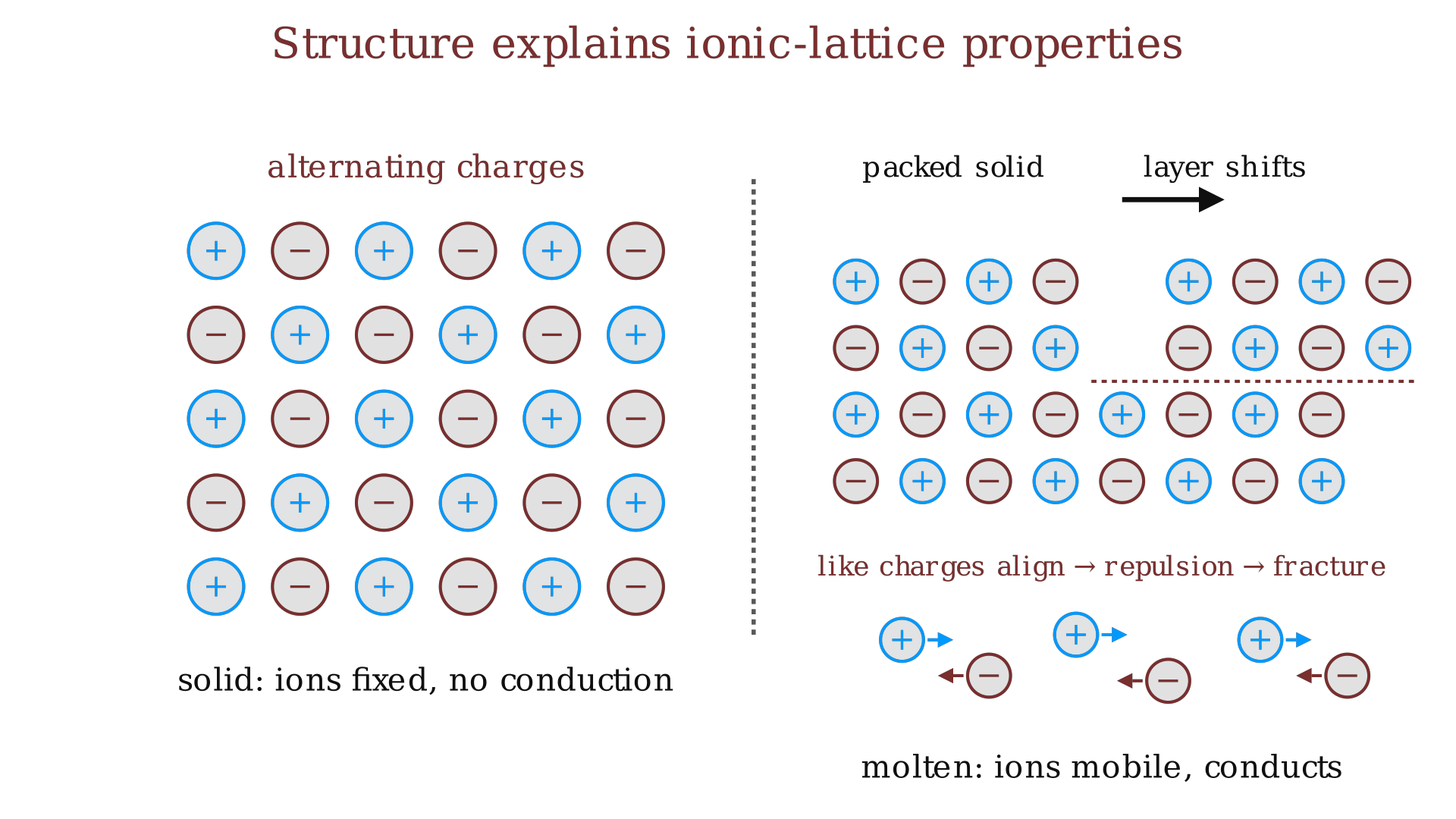
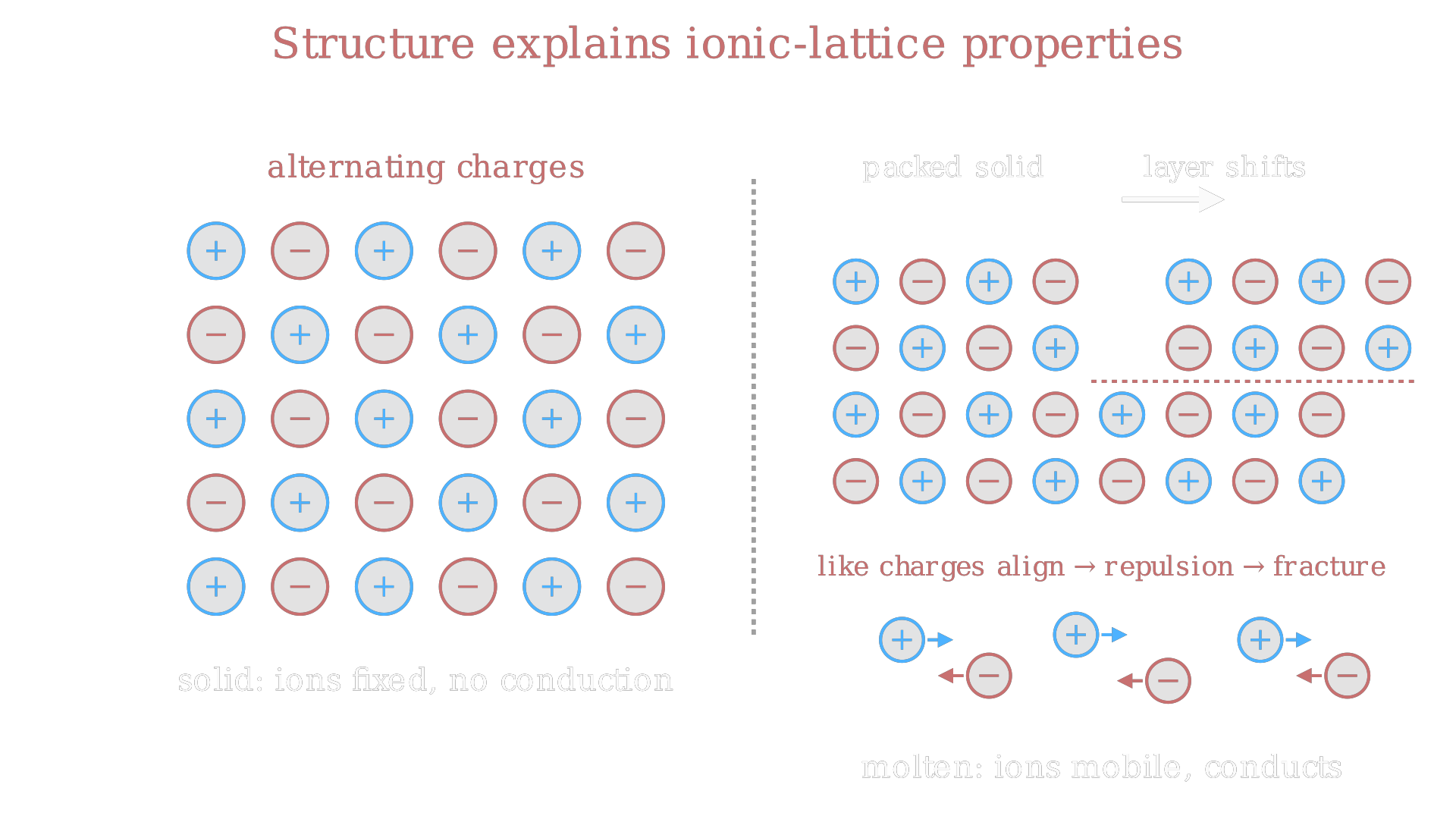
Ionic compounds form three-dimensional lattice structures represented by empirical formulas (not molecular formulas, since discrete molecules do not exist). Their properties follow directly from this structure:
离子化合物形成三维晶格(lattice)结构,用实验式(empirical formula)而非分子式表示——因为根本不存在独立的"分子"。下列性质都可直接由这种结构推出:
polar)的水分子能包围并稳定离子(水合作用)。
脆性:当晶格层发生错位时,同号电荷彼此对齐而相互排斥,晶体被撕开。
lattice enthalpy)衡量离子键的强度。离子电荷越高、离子半径越小,晶格焓越大(两者都增强静电吸引)。例如 MgO 的晶格焓远大于 NaCl,因为 Mg$^{2+}$、O$^{2-}$ 比 Na$^+$、Cl$^-$ 电荷更高、半径更小。
Worked Example — Constructing an Ionic Formula by Charge Balancing例题 — 用电荷平衡法写出离子化合物的化学式
Write the formula for aluminium sulfate, formed from Al$^{3+}$ and SO$_4^{2-}$.
写出硫酸铝的化学式,由 Al$^{3+}$ 与 SO$_4^{2-}$ 组成。
Worked Example: Ranking Lattice Enthalpy from Charge and Radius例题:由电荷与半径排出晶格焓大小
Rank NaCl, MgO, and MgCl$_2$ in order of increasing lattice enthalpy, and justify your answer using the ionic bonding model.
按晶格焓从小到大排列 NaCl、MgO、MgCl$_2$,并用离子键模型说明理由。
When a question says explain a high melting point, the mark scheme wants three links: strong electrostatic attraction between oppositely charged ions, in a giant lattice, so a large amount of energy is needed to overcome it. Writing “strong ionic bonds” alone, or “molecules separate”, loses marks — ionic compounds contain no molecules. For lattice enthalpy comparisons, always name both charge and radius, and say which one dominates.
题目要求解释(explain)高熔点时,评分标准通常要三个环节:带相反电荷的离子之间有强静电吸引、存在巨型晶格(giant lattice)、因此需要大量能量克服。只写“离子键很强”或“分子分开”会丢分——离子化合物中根本没有分子。比较晶格焓时,一定要同时写出电荷和半径,并指明哪个起主导作用。
Deduce the formulas of aluminium oxide and magnesium nitrate.推断氧化铝和硝酸镁的化学式。
Aluminium oxide: Al$^{3+}$ and O$^{2-}$, lowest common charge 6, so Al$_2$O$_3$. Magnesium nitrate: Mg$^{2+}$ and NO$_3^-$, so two nitrate ions are needed and the polyatomic ion goes in brackets: Mg(NO$_3$)$_2$.
氧化铝:Al$^{3+}$ 与 O$^{2-}$,电荷最小公倍数为 6,故为 Al$_2$O$_3$。硝酸镁:Mg$^{2+}$ 与 NO$_3^-$,需要两个硝酸根,多原子离子要加括号:Mg(NO$_3$)$_2$。
Explain why solid sodium chloride does not conduct electricity but molten sodium chloride does.解释为什么固体氯化钠不导电而熔融氯化钠导电。
In the solid the Na$^+$ and Cl$^-$ ions are held in fixed positions in the lattice, so there are no mobile charge carriers. When molten (or dissolved) the lattice breaks down and the ions are free to move and carry charge.
固体中 Na$^+$ 与 Cl$^-$ 被固定在晶格位置上,没有可自由移动的载流子。熔融(或溶解)后晶格被破坏,离子可自由移动并携带电荷。
Explain why MgO has a much larger lattice enthalpy than NaCl.解释为什么 MgO 的晶格焓远大于 NaCl。
Mg$^{2+}$ and O$^{2-}$ carry charges of 2+ and 2− compared with 1+ and 1− in NaCl, and their ionic radii are smaller. Higher charges and smaller radii give a larger electrostatic attraction ($F \propto q_1 q_2 / r^2$), so more energy is needed to separate the ions. Charge is the dominant factor here (a factor of four in $q_1q_2$).
Mg$^{2+}$ 和 O$^{2-}$ 的电荷为 2+ 和 2−,而 NaCl 中为 1+ 和 1−,且离子半径更小。电荷越高、半径越小,静电吸引越大($F \propto q_1 q_2 / r^2$),分离离子需要的能量更多。此处电荷是主导因素($q_1q_2$ 相差 4 倍)。
Calculate the number of ions in 0.250 mol of Al$_2$O$_3$.计算 0.250 mol Al$_2$O$_3$ 中离子的总数。
Each formula unit has 2 Al$^{3+}$ + 3 O$^{2-}$ = 5 ions. Amount of ions = 0.250 × 5 = 1.25 mol. Number = 1.25 × 6.02 × 10$^{23}$ = 7.53 × 10$^{23}$ ions (3 s.f.).
每个化学式单位含 2 个 Al$^{3+}$ + 3 个 O$^{2-}$ = 5 个离子。离子物质的量 = 0.250 × 5 = 1.25 mol。个数 = 1.25 × 6.02 × 10$^{23}$ = 7.53 × 10$^{23}$ 个(3 位有效数字)。
The Covalent Model共价模型
- Draw Lewis formulas and deduce molecular geometry and bond angles using VSEPR.
- Explain how bond polarity and molecular shape combine to give a net dipole moment.
- Identify London forces, dipole–dipole, dipole–induced dipole and hydrogen bonding, and rank them by strength.
- Predict boiling point and solubility trends from intermolecular forces.
- Deduce the number of sigma and pi bonds in a molecule.
- Deduce sp, sp$^2$ and sp$^3$ hybridization from electron domains (HL).
- Apply formal charge, resonance and expanded octets (HL).
- 画出(
draw)路易斯结构式,并用 VSEPR 推断(deduce)分子几何与键角。 - 解释(
explain)键的极性与分子形状如何共同决定净偶极矩(net dipole moment)。 - 识别伦敦力、偶极-偶极、偶极-诱导偶极和氢键,并按强度排序。
- 预测(
predict):由分子间作用力判断沸点与溶解度趋势。 - 推断分子中 sigma 键与 pi 键的数目。
- 推断:由电子域判断 sp、sp$^2$、sp$^3$ 杂化(HL)。
- 应用形式电荷、共振与扩展八隅体(HL)。
A covalent bond forms when two atoms share a pair of electrons. The electrostatic attraction between the shared electron pair and both positively charged nuclei holds the atoms together. The octet rule states that atoms tend to gain, lose, or share electrons to achieve 8 valence electrons (with exceptions).
两个原子共用一对电子时形成共价键(covalent bond)。共用电子对与两端带正电的原子核之间的静电吸引把两个原子连在一起。八隅体规则(octet rule)指出,原子倾向于通过得失或共用电子,使最外层达到 8 个价电子(有例外)。
Lewis Formulas路易斯结构式
Lewis formulas show all valence electrons — both bonding pairs and lone (non-bonding) pairs. You must be able to draw these for molecules and ions with up to four electron domains on each atom. Remember: some atoms can have fewer than an octet (e.g., BF$_3$ has only 6 electrons around boron).
路易斯结构(Lewis structure)画出所有价电子——既包括成键电子对,也包括孤对电子(lone pair)。你必须能为每个原子最多含 4 个电子域的分子和离子画出路易斯结构。注意:有些原子可以不满八隅体(例如 BF$_3$ 中硼周围只有 6 个电子)。
Bond Types and Strength键的类型与强度
Single bonds share one pair, double bonds share two pairs, triple bonds share three pairs. As bond order increases: bond strength increases and bond length decreases. A coordination bond (dative bond) is a covalent bond where both electrons come from the same atom (e.g., in NH$_4^+$, the N donates a lone pair to H$^+$).
单键共用 1 对电子,双键共用 2 对,三键共用 3 对。键级越高,键能(bond enthalpy)越大、键长(bond length)越短。配位键(coordinate bond / dative bond)是一种特殊的共价键,共用的两个电子全部来自同一个原子(例如 NH$_4^+$ 中,N 把自己的一对孤对电子给 H$^+$)。
VSEPR and Molecular GeometryVSEPR 与分子几何
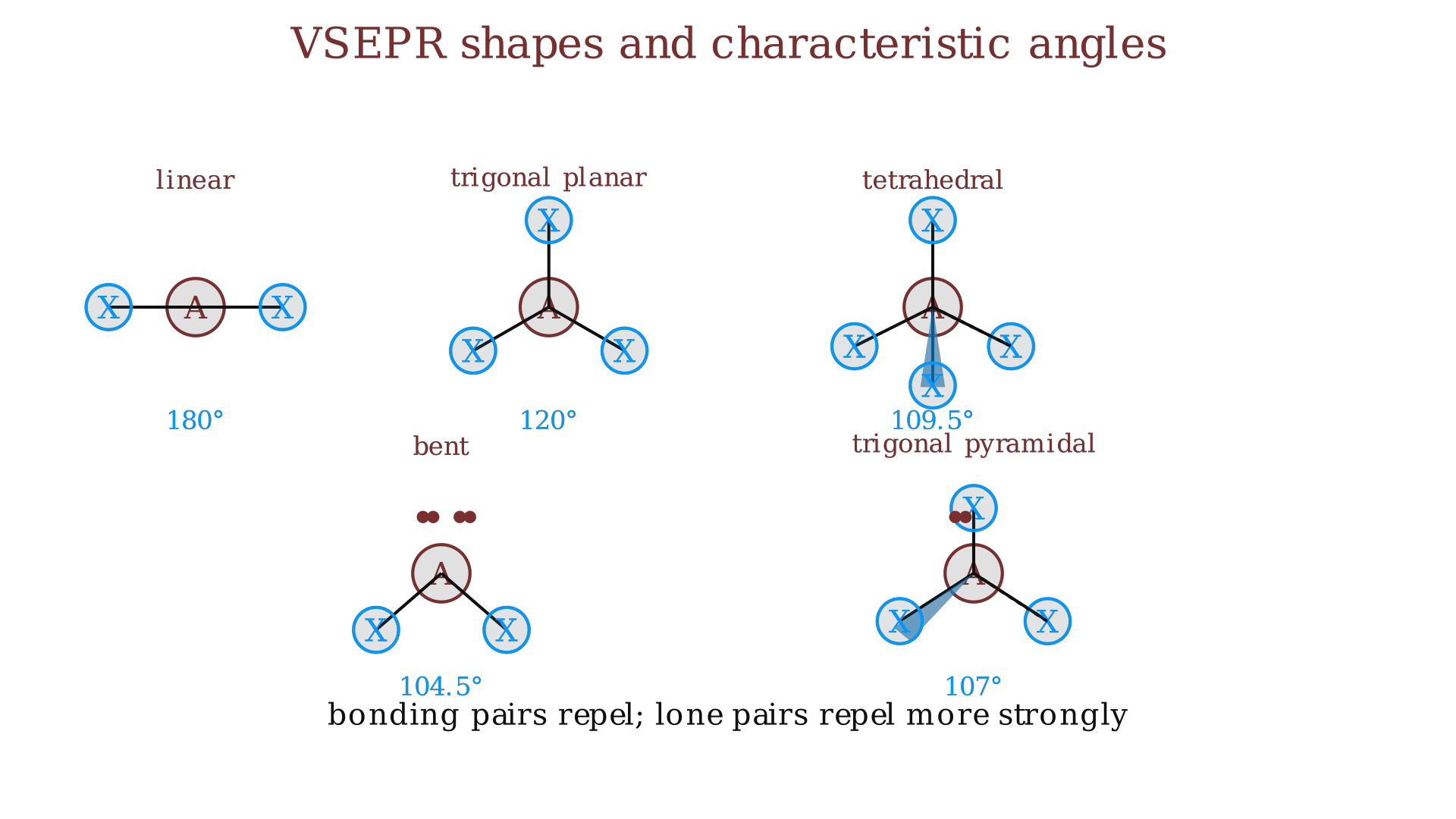
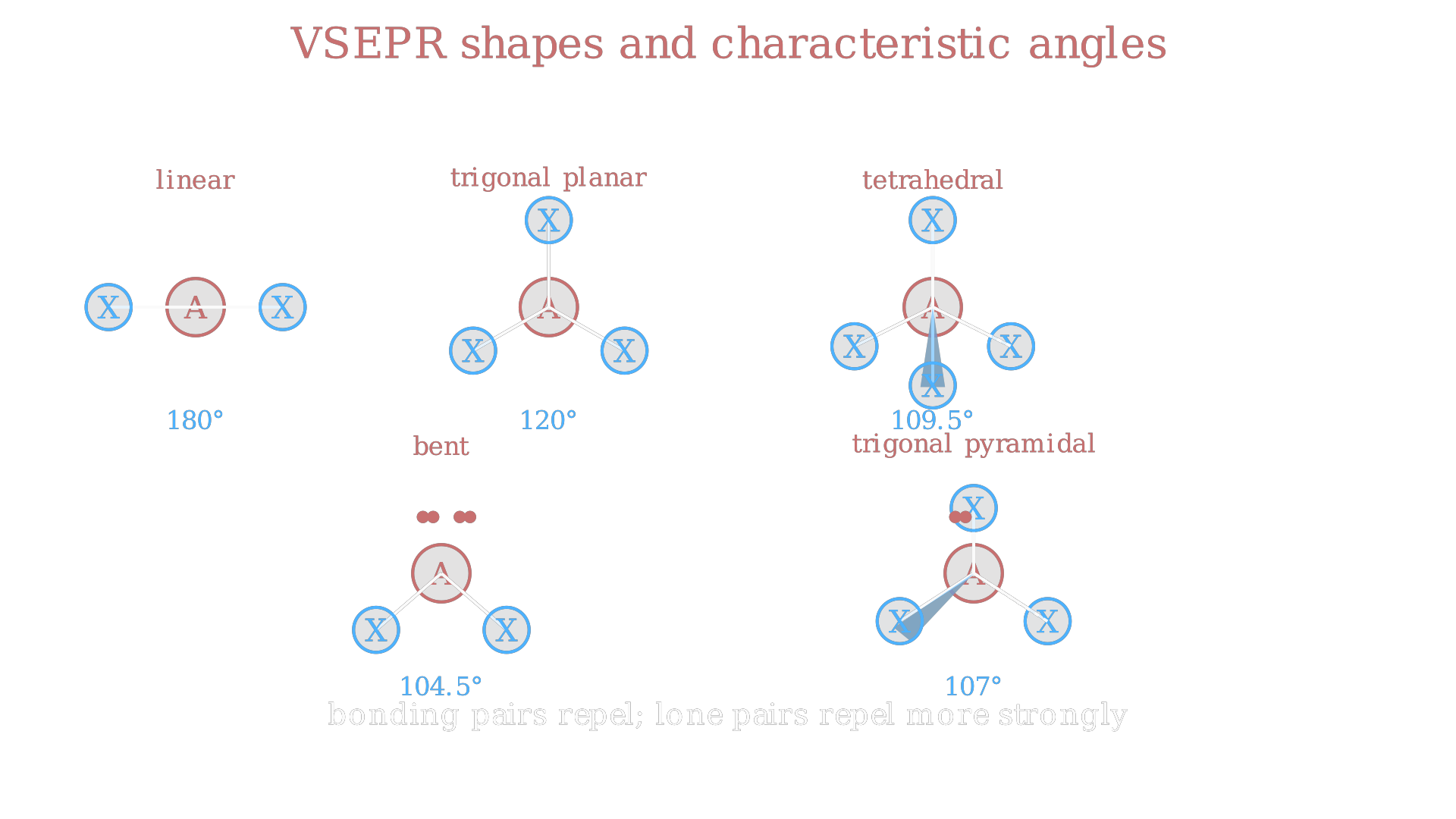
The Valence Shell Electron Pair Repulsion model predicts molecular shapes by minimizing repulsion between electron domains around a central atom. Lone pairs repel more than bonding pairs, reducing bond angles.
价层电子对互斥理论(VSEPR)通过让中心原子周围各电子域的排斥力最小,来预测分子几何(molecular geometry)。孤对电子的排斥力大于成键对,会把键角压小。
| Electron Domains | Bonding Pairs | Lone Pairs | Geometry | Bond Angle | Example |
|---|---|---|---|---|---|
| 2 | 2 | 0 | Linear | 180° | CO$_2$ |
| 3 | 3 | 0 | Trigonal planar | 120° | BF$_3$ |
| 3 | 2 | 1 | Bent (V-shaped) | <120° | SO$_2$ |
| 4 | 4 | 0 | Tetrahedral | 109.5° | CH$_4$ |
| 4 | 3 | 1 | Trigonal pyramidal | ~107° | NH$_3$ |
| 4 | 2 | 2 | Bent (V-shaped) | ~104.5° | H$_2$O |
| 电子域数 | 成键对 | 孤对 | 分子几何 | 键角 | 例子 |
|---|---|---|---|---|---|
| 2 | 2 | 0 | 直线形(Linear) | 180° | CO$_2$ |
| 3 | 3 | 0 | 平面三角形(Trigonal planar) | 120° | BF$_3$ |
| 3 | 2 | 1 | V 形(Bent) | <120° | SO$_2$ |
| 4 | 4 | 0 | 正四面体(Tetrahedral) | 109.5° | CH$_4$ |
| 4 | 3 | 1 | 三角锥(Trigonal pyramidal) | ~107° | NH$_3$ |
| 4 | 2 | 2 | V 形(Bent) | ~104.5° | H$_2$O |
| Electron Domains | Bonding Pairs | Lone Pairs | Geometry | Bond Angle | Example |
|---|---|---|---|---|---|
| 5 | 5 | 0 | Trigonal bipyramidal | 90°/120° | PCl$_5$ |
| 5 | 4 | 1 | See-saw | ~90°/~120° | SF$_4$ |
| 5 | 3 | 2 | T-shaped | ~90° | ClF$_3$ |
| 6 | 6 | 0 | Octahedral | 90° | SF$_6$ |
| 6 | 4 | 2 | Square planar | 90° | XeF$_4$ |
| 电子域数 | 成键对 | 孤对 | 分子几何 | 键角 | 例子 |
|---|---|---|---|---|---|
| 5 | 5 | 0 | 三角双锥(Trigonal bipyramidal) | 90°/120° | PCl$_5$ |
| 5 | 4 | 1 | 跷跷板形(See-saw) | ~90°/~120° | SF$_4$ |
| 5 | 3 | 2 | T 形(T-shaped) | ~90° | ClF$_3$ |
| 6 | 6 | 0 | 正八面体(Octahedral) | 90° | SF$_6$ |
| 6 | 4 | 2 | 平面正方形(Square planar) | 90° | XeF$_4$ |
All five shapes above start from an underlying trigonal bipyramidal or octahedral electron-domain geometry; lone pairs are placed to minimize repulsion (in a trigonal bipyramid, lone pairs always occupy the less-crowded equatorial positions first, since those have only two 90° neighbours instead of three).
以上五种形状都源自同一套底层电子域几何:三角双锥或正八面体;孤对的位置以排斥力最小为原则来放置(在三角双锥中,孤对总是优先占据不那么拥挤的赤道位置,因为那里只有两个 90° 近邻,而不是三个)。
Bond Polarity and Molecular Polarity键的极性与分子极性
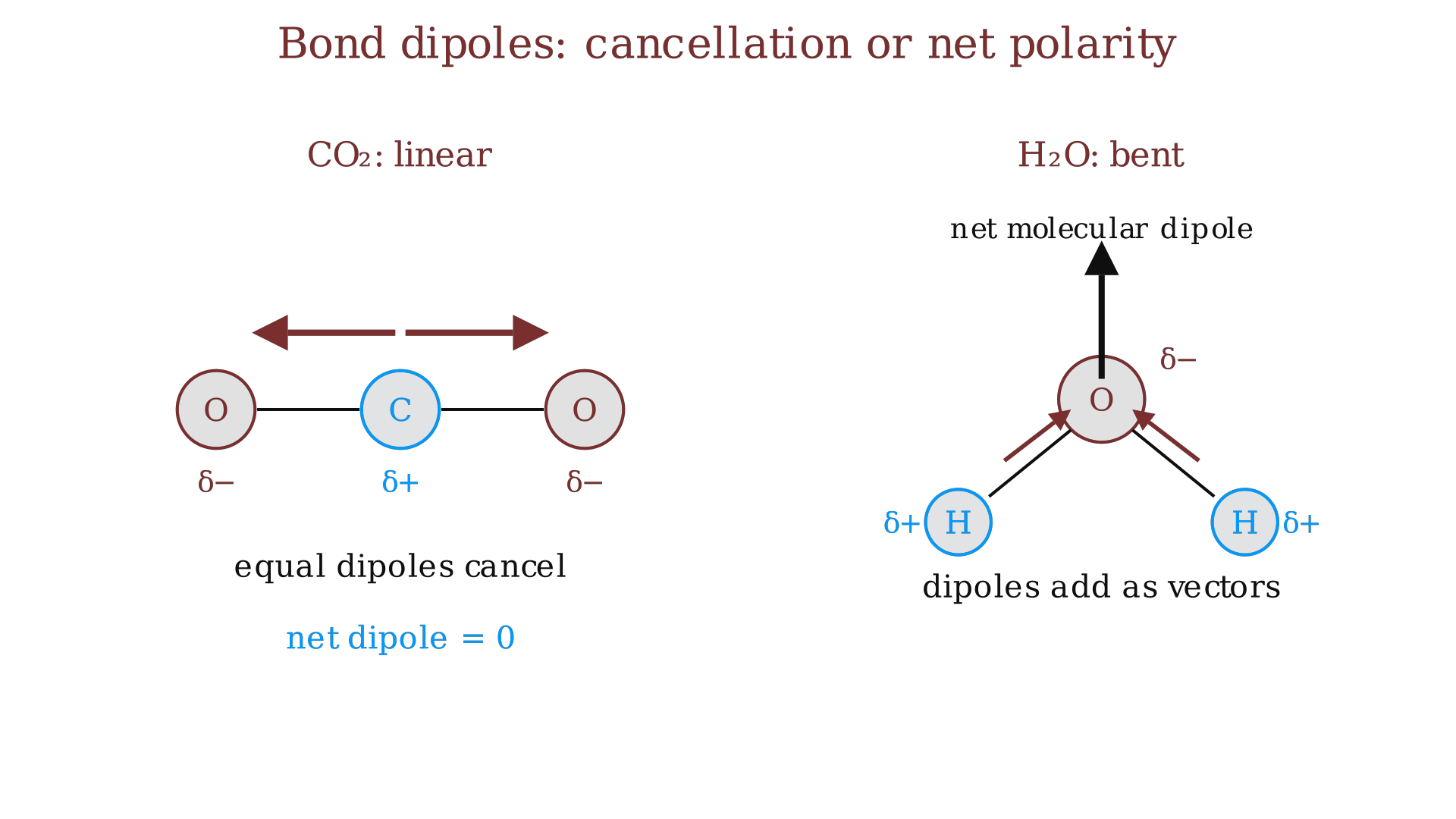
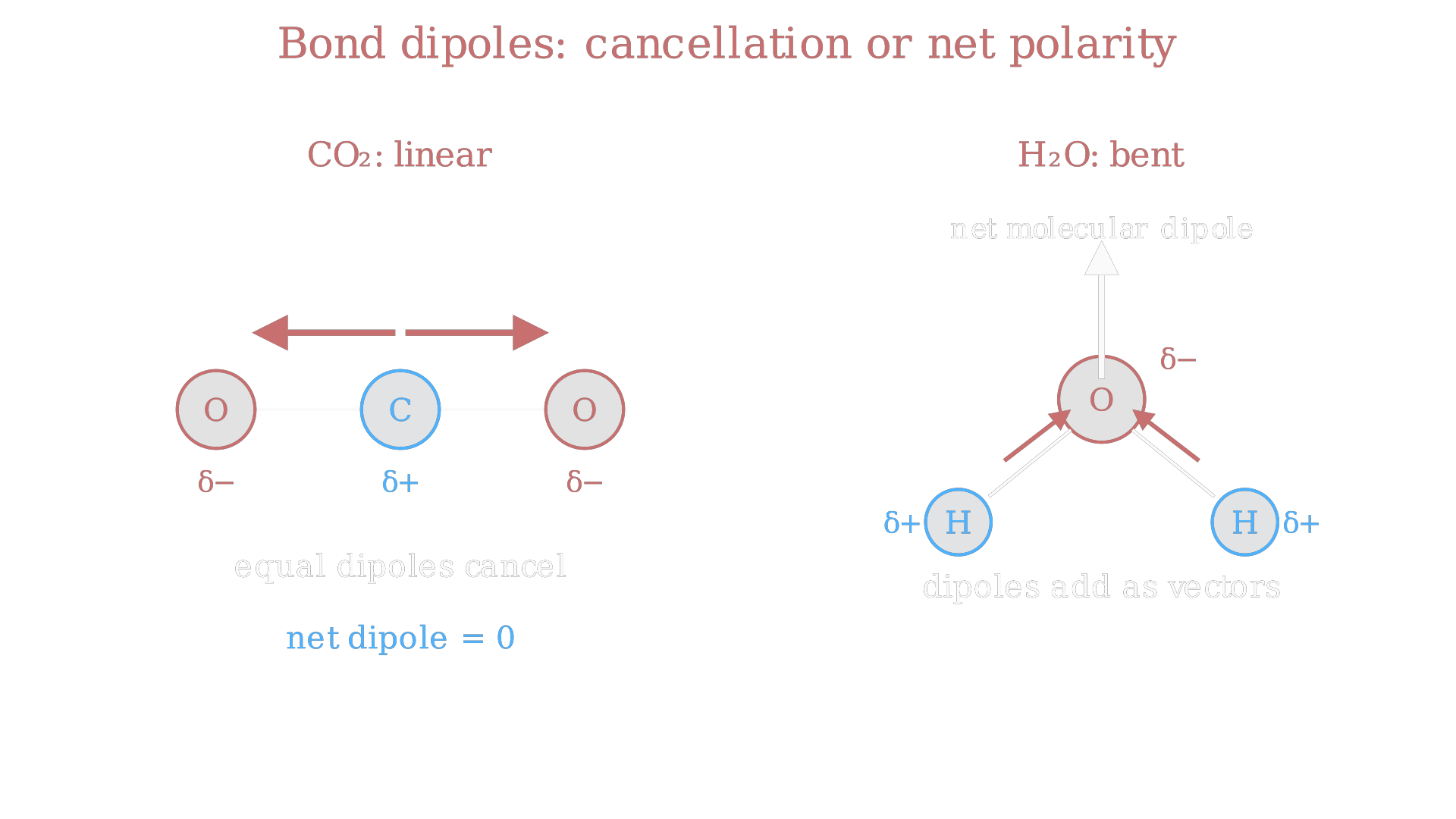
Bond polarity arises from a difference in electronegativity between bonded atoms. The greater the difference, the more polar the bond. Molecular polarity depends on both bond polarity and molecular geometry — symmetrical molecules can have polar bonds but be non-polar overall (e.g., CO$_2$, CCl$_4$) because the dipoles cancel.
键的极性来自两个成键原子之间的电负性(electronegativity)差。差值越大,键越极性(polar)。分子极性同时取决于键的极性和分子几何——对称的分子即使含有极性键,整体也可能是非极性(non-polar)的(如 CO$_2$、CCl$_4$),因为各键的偶极相互抵消。
Covalent Network Structures共价网状结构
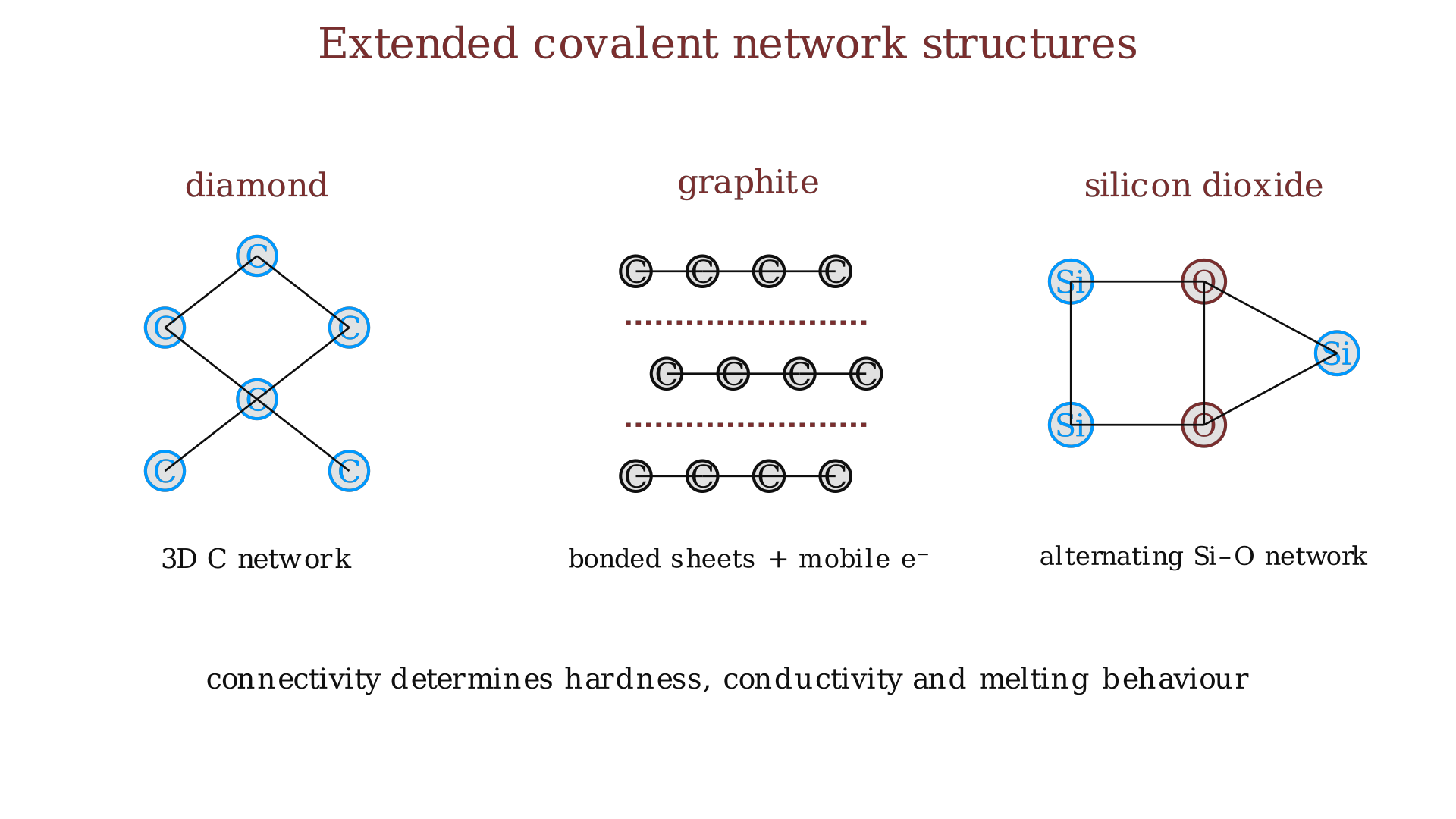
Carbon and silicon form covalent network structures — giant lattices of covalently bonded atoms. Diamond (each C bonded to 4 others tetrahedrally) is extremely hard and does not conduct. Graphite (layers of hexagonal C with delocalized electrons between layers) conducts electricity and is a lubricant. Graphene is a single layer of graphite. Fullerenes (C$_{60}$) are spherical molecules. Silicon and SiO$_2$ also form network structures.
碳和硅可以形成共价网状结构——由共价键连接的巨型晶格(lattice)。金刚石(每个 C 与 4 个 C 以正四面体方式成键)极硬、不导电。石墨(六元环碳层之间夹着可离域电子)能导电、可作润滑剂。石墨烯是单层石墨。富勒烯(C$_{60}$)是球形分子。硅与 SiO$_2$ 同样形成网状结构。
Net Dipole Moment: Adding Bond Dipoles as Vectors净偶极矩:把键偶极当作矢量相加
Each polar bond has a bond dipole: a vector pointing from the δ+ atom (lower electronegativity) towards the δ− atom. The net dipole moment of the molecule ($\mu$, measured in debye, D) is the vector sum of all bond dipoles. If the bond dipoles are equal and arranged symmetrically they cancel, giving $\mu = 0$ and a non-polar molecule; if they do not cancel, the molecule is polar and has a permanent dipole. Lone pairs matter because they break the symmetry of the molecule.
每个极性键都有一个键偶极(bond dipole):这是一个矢量,从 δ+ 原子(电负性较低)指向 δ− 原子。分子的净偶极矩(net dipole moment,$\mu$,单位德拜 D)是所有键偶极的矢量和。若各键偶极大小相等且对称排列,则相互抵消,$\mu = 0$,分子为非极性;若不能抵消,分子为极性并具有永久偶极。孤对电子之所以重要,是因为它们会破坏分子的对称性。
Intermolecular Forces分子间作用力
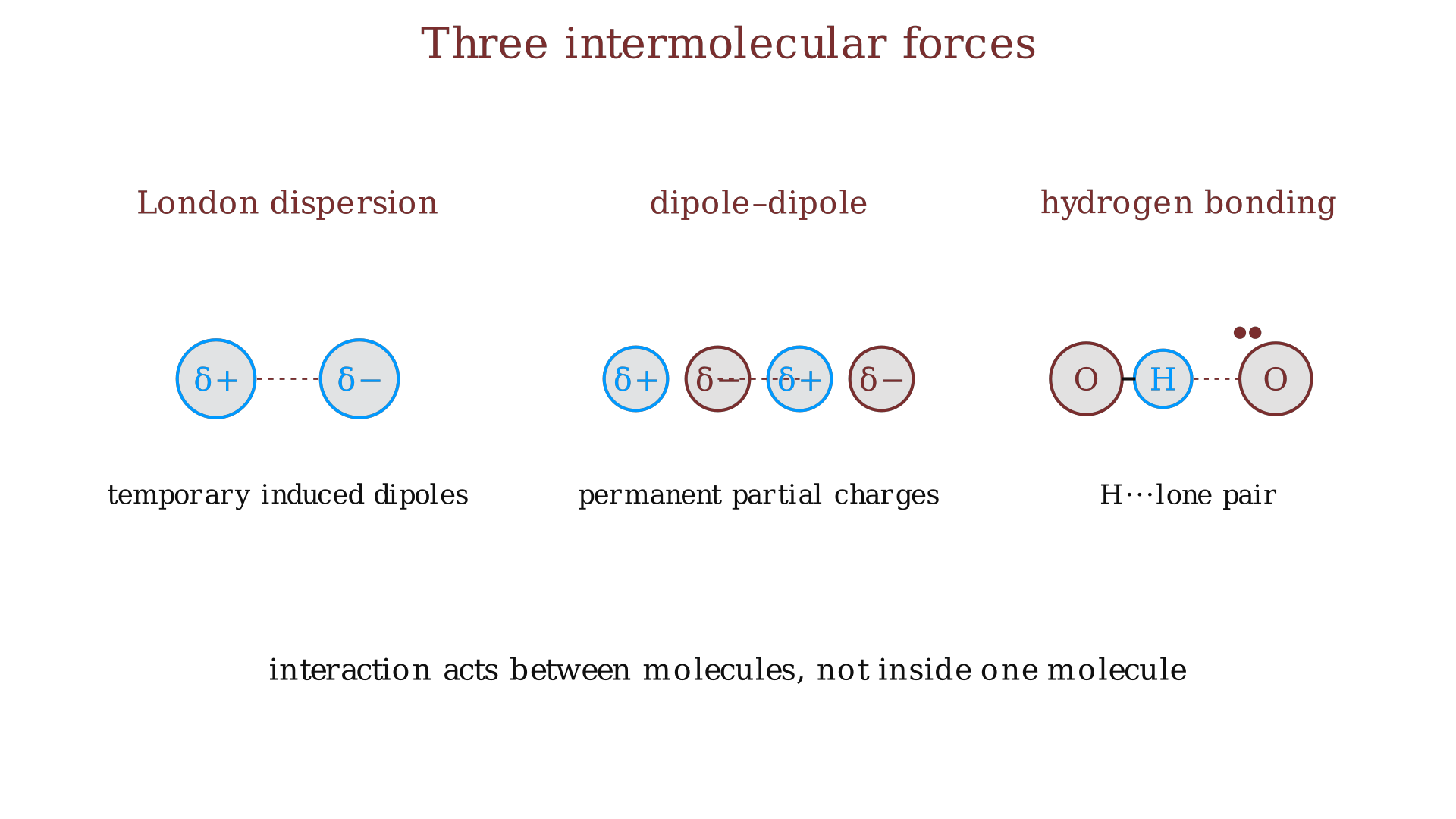
The forces between molecules (not within them) determine physical properties like boiling point, volatility, and solubility. From weakest to strongest:
分子之间(而非分子内部)的作用力——即分子间作用力(intermolecular force)——决定了沸点、挥发性、溶解度等物理性质。按强度从弱到强:
London dispersion force):存在于所有分子之中。电子密度瞬时涨落产生瞬时偶极,互相诱导而产生吸引。分子越大、电子越多、越易极化,色散力就越强。这也是范德华力(van der Waals force)的主要组成之一。
偶极-偶极作用力(dipole-dipole):极性分子之间。一个分子的 δ+ 端吸引另一个分子的 δ− 端。
氢键(hydrogen bond):一种特殊、较强的偶极-偶极作用。当 H 与 N、O 或 F 直接成键,并与相邻分子上 N、O、F 的孤对电子相互作用时形成。它解释了 H$_2$O、NH$_3$、HF 异常偏高的沸点。
Dipole–Induced Dipole and Comparing Intermolecular Forces偶极-诱导偶极与分子间作用力的比较
A dipole–induced dipole force acts between a polar molecule and a non-polar one: the permanent dipole distorts the electron cloud of its neighbour, inducing a temporary dipole that is then attracted to it. It is why small amounts of non-polar O$_2$ dissolve in water. All three types of force (London, dipole–dipole, hydrogen bonding) are far weaker than covalent bonds, which is why boiling a liquid breaks intermolecular forces but does not break the molecules.
偶极-诱导偶极(dipole-induced dipole)作用发生在极性分子与非极性分子之间:永久偶极使邻近分子的电子云变形,诱导出瞬时偶极,二者互相吸引。这就是少量非极性 O$_2$ 能溶于水的原因。三类作用力(伦敦力、偶极-偶极、氢键)都远弱于共价键,所以液体沸腾时破坏的是分子间作用力,而不是分子本身。
Relative strength: hydrogen bonding > dipole–dipole > London for molecules of similar molar mass. London forces grow with the number of electrons, so for large molecules they can outweigh dipole–dipole. Compare butane ($M_\mathrm{r}=58$, London only, bp −1 °C), propanone ($M_\mathrm{r}=58$, dipole–dipole, bp 56 °C) and propan-1-ol ($M_\mathrm{r}=60$, hydrogen bonding, bp 97 °C). The group 14 hydrides CH$_4$, SiH$_4$, GeH$_4$, SnH$_4$ (bp −162, −112, −88, −52 °C) rise smoothly because only London forces act and they strengthen with size; H$_2$O (100 °C) is far above H$_2$S (−60 °C) because of hydrogen bonding.
相对强度:摩尔质量相近时,氢键 > 偶极-偶极 > 伦敦力。伦敦力随电子数增加而增强,所以大分子的伦敦力可能超过偶极-偶极。比较丁烷($M_\mathrm{r}=58$,仅伦敦力,沸点 −1 °C)、丙酮($M_\mathrm{r}=58$,偶极-偶极,沸点 56 °C)与丙-1-醇($M_\mathrm{r}=60$,氢键,沸点 97 °C)。第 14 族氢化物 CH$_4$、SiH$_4$、GeH$_4$、SnH$_4$(沸点 −162、−112、−88、−52 °C)平稳上升,因为只有伦敦力且随分子增大而增强;H$_2$O(100 °C)远高于 H$_2$S(−60 °C),原因是氢键。
Solubility: “like dissolves like”. Polar molecules and those able to form hydrogen bonds with water (ethanol, glucose, NH$_3$) dissolve in water because the new water–solute attractions compensate for breaking water–water hydrogen bonds. Non-polar molecules (hexane, I$_2$) dissolve in non-polar solvents, where London forces replace London forces, but not in water.
溶解度:“相似相溶”(like dissolves like)。极性分子以及能与水形成氢键的分子(乙醇、葡萄糖、NH$_3$)能溶于水,因为新形成的水-溶质吸引力补偿了破坏水-水氢键所需的能量。非极性分子(己烷、I$_2$)溶于非极性溶剂(伦敦力取代伦敦力),而不溶于水。
Hybridization: sp, sp$^2$ and sp$^3$ (HL)杂化:sp、sp$^2$ 与 sp$^3$(HL)
HL Hybridization is the mixing of atomic orbitals on one atom to give equivalent hybrid orbitals that point to the corners of the electron-domain geometry. The number of hybrid orbitals equals the number of electron domains (bonding regions and lone pairs) around the atom. Each hybrid orbital forms a sigma ($\sigma$) bond by head-on overlap or holds a lone pair. Unhybridized p orbitals overlap sideways to form pi ($\pi$) bonds, so a double bond is 1σ + 1π and a triple bond is 1σ + 2π.
HL 杂化(hybridization)是同一原子上的原子轨道混合,形成指向电子域几何顶点的等价杂化轨道。杂化轨道数等于该原子周围的电子域数(成键区域加孤对)。每个杂化轨道以头碰头方式形成一个sigma($\sigma$)键,或容纳一对孤对电子。未参与杂化的 p 轨道侧向重叠形成pi($\pi$)键,因此双键 = 1 个 σ + 1 个 π,三键 = 1 个 σ + 2 个 π。
Method: draw the Lewis formula, count electron domains on the atom (a multiple bond counts as one domain), then match: 4 → sp$^3$, 3 → sp$^2$, 2 → sp. Misconception: the lone pair on N in NH$_3$ is a domain, so N is sp$^3$, not sp$^2$; and hybridization describes bonding in a molecule — it is not a separate shape rule that overrides VSEPR.
方法:画出路易斯结构,数出该原子的电子域(多重键只算一个域),然后对应:4 → sp$^3$,3 → sp$^2$,2 → sp。常见误区:NH$_3$ 中 N 的孤对也是一个电子域,所以 N 是 sp$^3$ 而不是 sp$^2$;杂化只是对成键的描述,并不是另一套能推翻 VSEPR 的形状规则。
Chromatography色谱法
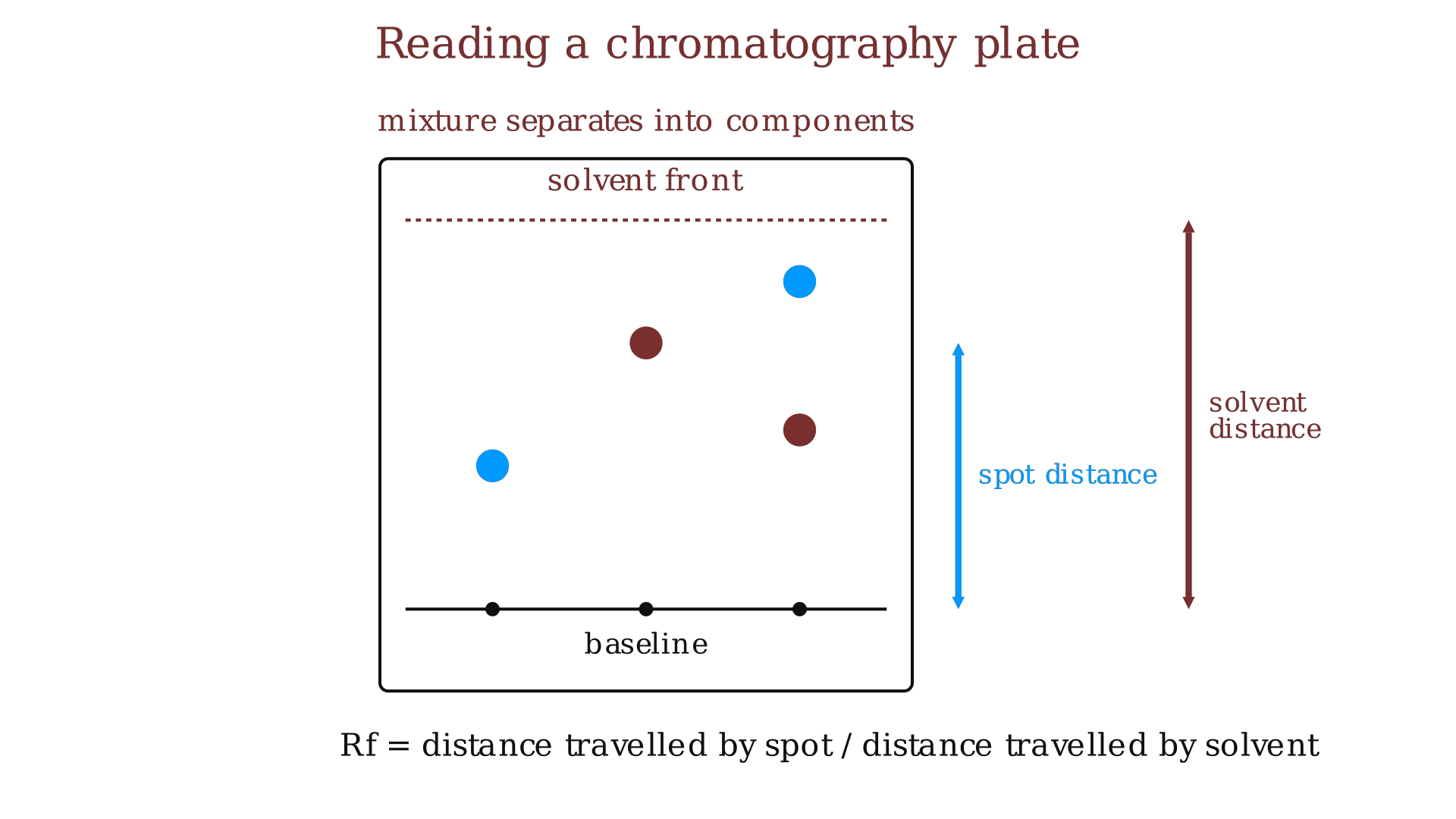
Chromatography separates mixture components based on their different affinities (via intermolecular forces) for a mobile phase and a stationary phase. The retardation factor $R_f$ quantifies how far a substance moves relative to the solvent front:
色谱法(chromatography)利用混合物各组分对流动相(mobile phase)和固定相(stationary phase)亲和力的差异(这种亲和力来自分子间作用力)来分离。比移值(retardation factor)$R_f$ 衡量物质相对溶剂前沿移动的距离:
resonance,2.2.11–12):同一物种存在多种合理的路易斯结构时,真实结构是这些结构的加权平均。苯是经典例子——所有 C–C 键长完全相等,介于单键和双键之间。
扩展八隅体(expanded octet,2.2.13):第 3 周期及以下的原子可以有 5 或 6 个电子域(例如 PCl$_5$、SF$_6$)。用 VSEPR 处理三角双锥和八面体几何。
形式电荷(formal charge,2.2.14):用于判断哪种路易斯结构最合理。形式电荷 = 价电子数 − 孤对电子数 − 1/2(成键电子数)。各原子形式电荷越接近零,结构越优。
σ 键与 π 键(sigma bond / pi bond,2.2.15):σ ($\sigma$) 键由轨道沿键轴正面重叠形成;π ($\pi$) 键由 p 轨道在键轴上下方侧面重叠形成。单键 = 1σ;双键 = 1σ + 1π;三键 = 1σ + 2π。
杂化(hybridization,2.2.16):sp$^3$ = 正四面体(4 域);sp$^2$ = 平面三角形(3 域);sp = 直线形(2 域)。杂化方式与电子域几何一一对应。
Worked Example — Predicting Shape and Polarity
Determine the shape, bond angle, and polarity of SCl$_2$.
例题 — 预测 SCl$_2$ 的形状和极性
判断 SCl$_2$ 的分子几何、键角和极性。
Worked Example (HL) — Formal Charge and Choosing the Best Lewis Structure
For the cyanate ion, OCN$^-$, one possible Lewis structure places the negative charge on oxygen: O$^{-}$–C≡N. Calculate the formal charge on each atom and decide if this is the preferred structure.
C: 4 valence electrons, 0 lone pairs, 4 bonds total (8 electrons) → FC = 4 − 0 − 4 = 0.
N: 5 valence electrons, 1 lone pair (2 electrons), 3 bonds (6 electrons) → FC = 5 − 2 − 3 = 0.
例题(HL) — 形式电荷与选择最优路易斯结构
氰酸根离子 OCN$^-$ 的一种可能路易斯结构把负电荷放在氧上:O$^{-}$–C≡N。计算每个原子的形式电荷,并判断这是否是最优结构。
C:4 个价电子,0 对孤对电子,共 4 个键(8 个电子)→ 形式电荷 = 4 − 0 − 4 = 0。
N:5 个价电子,1 对孤对电子(2 个电子),3 个键(6 个电子)→ 形式电荷 = 5 − 2 − 3 = 0。
Worked Example (HL): VSEPR with an Expanded Octet
Determine the electron-domain geometry, molecular geometry, and approximate bond angles in ClF$_3$.
例题(HL):扩展八隅体下的 VSEPR
判断 ClF$_3$ 的电子域几何、分子几何以及大致键角。
Worked Example (HL): Resonance and Hybridization in Benzene
Explain why all six C-C bonds in benzene, C$_6$H$_6$, are equal in length, and determine the hybridization of each carbon atom and the total number of sigma and pi bonds in the ring.
例题(HL):苯中的共振与杂化
解释为什么苯(C$_6$H$_6$)中全部 6 条 C-C 键键长相等,并判断每个碳原子的杂化方式,以及环中 σ 键与 π 键的总数。
For explain questions on boiling point, name the type of intermolecular force present, say it is the intermolecular force (not the covalent bond) that is overcome, and compare strength. For hydrogen bonding, state that H is bonded to N, O or F and interacts with a lone pair on another N, O or F. For polarity, write both parts: polar bonds and an asymmetric shape so the dipoles do not cancel. Lewis formulas lose a mark for a missing lone pair or a charge not shown on an ion.
解释沸点的题目:写明存在的分子间作用力类型,指出被克服的是分子间作用力(而不是共价键),并比较强弱。写氢键时要说明 H 与 N、O 或 F 相连,并且与另一个 N、O 或 F 上的孤对电子作用。写极性时要两部分都写:有极性键,并且形状不对称使偶极不能抵消。路易斯结构漏画孤对电子或离子不标电荷都会丢分。
Deduce the shape, bond angle and polarity of NH$_3$.推断 NH$_3$ 的形状、键角与极性。
Four electron domains (3 bonding + 1 lone pair) give a trigonal pyramidal shape. The lone pair repels more strongly than bonding pairs, so the angle is about 107°, less than 109.5°. The N–H dipoles do not cancel in this asymmetric shape, so NH$_3$ is polar.
4 个电子域(3 个成键 + 1 个孤对)给出三角锥形。孤对的排斥比成键电子对更强,键角约 107°,小于 109.5°。在这种不对称形状中 N–H 偶极不能抵消,故 NH$_3$ 为极性分子。
Explain why HF (bp 19.5 °C) boils at a much higher temperature than HCl (bp −85 °C).解释为什么 HF(沸点 19.5 °C)的沸点远高于 HCl(沸点 −85 °C)。
In HF the hydrogen is bonded to the very electronegative F and interacts with a lone pair on a neighbouring F, forming hydrogen bonds. HCl molecules have only dipole–dipole and London forces, which are weaker. More energy is needed to overcome the intermolecular forces in HF.
HF 中的氢与电负性很大的 F 相连,并与相邻分子 F 上的孤对电子作用,形成氢键。HCl 分子之间只有偶极-偶极和伦敦力,较弱。克服 HF 的分子间作用力需要更多能量。
Explain why CCl$_4$ is non-polar although each C–Cl bond is polar.解释为什么 CCl$_4$ 虽含极性 C–Cl 键却是非极性分子。
The four C–Cl bond dipoles are equal in size and point to the corners of a regular tetrahedron. Their vector sum is zero, so the net dipole moment is zero.
四个 C–Cl 键偶极大小相等,指向正四面体的四个顶点,矢量和为零,所以净偶极矩为零。
For HCN (H–C≡N), state the number of σ and π bonds and the hybridization of carbon (HL).对于 HCN(H–C≡N),写出 σ 键与 π 键的数目以及碳的杂化类型(HL)。
H–C is one σ bond; C≡N is 1σ + 2π. Total: 2 σ and 2 π. Carbon has two electron domains (one to H, one triple bond to N), so it is sp hybridized with a linear 180° geometry; its two unhybridized p orbitals form the two π bonds.
H–C 为 1 个 σ 键;C≡N 为 1 个 σ + 2 个 π。合计 2 个 σ 与 2 个 π。碳有两个电子域(一个连 H,一个与 N 三键),故为 sp 杂化,直线形 180°;其两个未杂化的 p 轨道形成两个 π 键。
The Metallic Model金属模型
- Describe the metallic bond as attraction between cations and delocalized electrons.
- Explain electrical and thermal conductivity, malleability and ductility of metals.
- Predict relative metallic bond strength and melting point from cation charge and radius.
- Explain why transition elements have high melting points using delocalized d-electrons (HL).
- 描述(
describe)金属键:阳离子与离域电子之间的吸引。 - 解释金属的导电性、导热性、延展性。
- 预测:由阳离子电荷与半径判断金属键强弱和熔点高低。
- 解释:用离域 d 电子说明过渡元素熔点高的原因(HL)。
A metallic bond is the electrostatic attraction between a lattice of metal cations and a "sea" of delocalized electrons. This model elegantly explains all characteristic metallic properties.
金属键(metallic bond)是金属阳离子晶格(lattice)与离域电子"海"之间的静电吸引。这个简单模型可以漂亮地解释金属几乎所有的特征性质。
Factors Affecting Metallic Bond Strength影响金属键强度的因素
The strength of the metallic bond (and therefore the melting point) depends on the charge of the cation and the radius of the metal ion. Higher charge and smaller radius both increase the attraction between cations and the electron sea. This explains why Na (1+ charge, larger) has a lower melting point than Mg (2+ charge, smaller).
金属键的强度(进而决定熔点)取决于阳离子的电荷和半径。电荷越高、半径越小,阳离子与电子海的吸引越强。这就解释了为什么 Na(电荷 +1、半径较大)的熔点低于 Mg(电荷 +2、半径较小)。
Transition Elements: Why d-Electrons Strengthen the Metallic Bond (HL)过渡元素:为什么 d 电子使金属键更强(HL)
HL In s-block metals only the outer s electrons are delocalized (Na: one per atom; Mg: two). In transition elements the 4s and the nearby 3d orbitals are very close in energy, so the d-electrons as well as the s electrons can be delocalized into the electron sea. More delocalized electrons per atom means a higher charge density in the sea and a stronger attraction to the cation lattice. Together with the small metallic radii of the d-block, this gives transition metals high melting points, high hardness and good electrical conductivity. For example, potassium (one delocalized electron, large radius) melts at 63 °C, whereas chromium melts at 1907 °C.
HL 在 s 区金属中,只有最外层 s 电子离域(Na 每原子 1 个;Mg 每原子 2 个)。在过渡元素中,4s 与邻近的 3d 轨道能量非常接近,因此 d 电子(d-electrons)和 s 电子都可以离域进入电子海。每个原子贡献的离域电子更多,电子海电荷密度更大,与阳离子晶格的吸引也更强。再加上 d 区金属半径较小,过渡金属熔点高、硬度大、导电性好。例如钾(1 个离域电子、半径大)熔点为 63 °C,而铬熔点为 1907 °C。
Misconception: the number of delocalized electrons is not simply the group number for a transition metal, and not every d-electron is equally delocalized. For IB, state the idea: d-electrons add to the delocalized electrons, strengthening the metallic bond.
常见误区:对过渡金属而言,离域电子数并不简单等于族数,也不是每个 d 电子的离域程度都相同。IB 考试中答出核心观点即可:d 电子增加了离域电子数,使金属键增强。
Worked Example — Ranking Metallic Melting Points例题 — 比较金属熔点高低
Rank Na, Mg, and Al in order of increasing melting point, and justify using the metallic bonding model.
按熔点从低到高排列 Na、Mg、Al,并用金属键模型说明理由。
Worked Example — Explaining the High Melting Point of a Transition Metal (HL)例题 — 解释过渡金属的高熔点(HL)
Potassium melts at 63 °C (336 K) and chromium at 1907 °C (2180 K). Using the metallic bonding model, explain the difference. Metallic radii: K 227 pm, Cr 128 pm.
钾的熔点为 63 °C(336 K),铬的熔点为 1907 °C(2180 K)。用金属键模型解释这一差异。金属半径:K 227 pm,Cr 128 pm。
Metallic bonding answers must say delocalized electrons and cations — “free electrons between atoms” or “ions swimming in a sea” are weaker wording. For melting-point comparisons give the charge and radius argument, and for an HL transition-metal question add the delocalized d-electrons. Do not say metals conduct because “electrons flow through the bonds”; say mobile delocalized electrons carry charge.
回答金属键时必须写出离域电子和阳离子——“原子间的自由电子”或“离子漂在海里”措辞较弱。比较熔点要同时给出电荷和半径的论证;HL 过渡金属题还要加上离域 d 电子。不要说金属导电是因为“电子流过键”,应说成可移动的离域电子携带电荷。
Describe the metallic bond.描述金属键。
The metallic bond is the electrostatic attraction between a lattice of positive metal ions (cations) and a sea of delocalized electrons.
金属键是金属阳离子晶格与离域电子海之间的静电吸引。
Explain why magnesium has a higher melting point than sodium.解释为什么镁的熔点高于钠。
Mg contributes two delocalized electrons per atom (Mg$^{2+}$) against one for Na (Na$^+$), and Mg$^{2+}$ is smaller than Na$^+$. Higher charge and smaller radius give stronger attraction between cations and the electron sea, so more energy is needed to melt Mg.
每个 Mg 原子贡献 2 个离域电子(Mg$^{2+}$),Na 只有 1 个(Na$^+$),且 Mg$^{2+}$ 比 Na$^+$ 小。电荷更高、半径更小,阳离子与电子海吸引更强,熔化 Mg 需要更多能量。
Explain why metals are malleable but ionic solids are brittle.解释为什么金属有延展性而离子固体易碎。
In a metal, layers of cations slide over each other and the delocalized electrons keep surrounding them, so the bonding is maintained. In an ionic solid, sliding moves like-charged ions next to each other; repulsion then splits the crystal.
金属中阳离子层相互滑动,离域电子仍包围着它们,键合得以保持。离子固体中滑动会使同种电荷的离子相邻,排斥力使晶体碎裂。
Explain why chromium melts at a much higher temperature than potassium (HL).解释为什么铬的熔点远高于钾(HL)。
Chromium is a transition element: its 3d electrons as well as its 4s electron can be delocalized, giving more delocalized electrons per atom than K (one). Together with its smaller radius this gives a stronger attraction to the cations, so more energy is needed to melt it.
铬是过渡元素:3d 电子和 4s 电子都可以离域,每原子的离域电子多于 K(1 个)。再加上半径更小,与阳离子之间吸引更强,熔化需要更多能量。
From Models to Materials从模型到材料
- Use the bonding triangle to classify a compound from electronegativity data.
- Explain why alloys are harder than pure metals.
- Distinguish addition and condensation polymers and deduce repeating units (HL).
- Discuss plastics: biodegradability, recycling and environmental impact.
- Identify the small molecule eliminated in condensation polymerization (HL).
- 利用成键三角形,由电负性数据归类(
classify)化合物。 - 解释合金为何比纯金属更硬。
- 区分加成聚合物与缩合聚合物,并推断重复单元(HL)。
- 讨论(
discuss)塑料:生物降解性、回收与环境影响。 - 指出缩合聚合中脱去的小分子(HL)。
The Bonding Triangle成键三角形(bonding triangle)
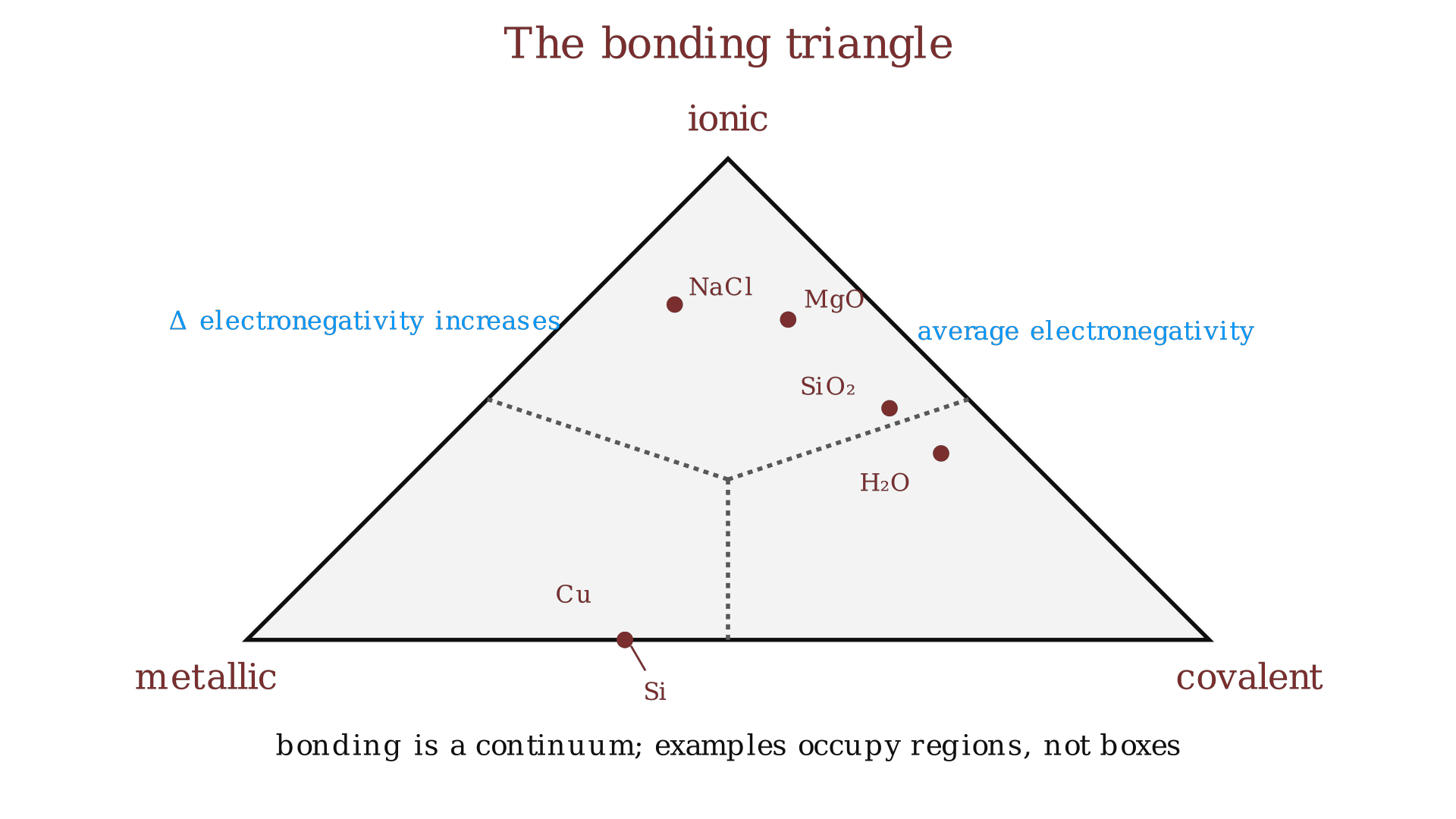
Real bonding is not purely ionic, covalent, or metallic — it exists on a continuum. The bonding triangle (provided in the data booklet) places compounds according to the relative contributions of all three bonding types. A compound's position is determined by electronegativity differences and average electronegativities of the atoms involved. The position predicts physical properties.
真实化学键并非纯粹的离子、共价或金属键——三者是一个连续过渡。成键三角形(bonding triangle,数据手册中提供)按三种成键方式各自的贡献,把化合物放在三角形不同位置。位置由原子电负性(electronegativity)的差值与平均值共同决定,进而可以预测物理性质。
Alloys合金
Alloys are mixtures of a metal with other metals or non-metals. The different-sized atoms disrupt the regular lattice, preventing layers from sliding as easily. This makes alloys harder and stronger than pure metals. Examples include bronze (Cu + Sn), brass (Cu + Zn), and stainless steel (Fe + Cr + Ni). Alloys are mixtures, not compounds — they have no fixed ratio.
合金(alloys)是金属与其他金属或非金属的混合物。大小不同的原子打乱了规则晶格,使各层不易彼此滑动,因此合金通常比纯金属更硬、更强。常见例子:青铜(Cu + Sn)、黄铜(Cu + Zn)、不锈钢(Fe + Cr + Ni)。合金属于混合物,不是化合物——配比不固定。
Polymers聚合物(polymers)
Polymers are large molecules (macromolecules) built from repeating units called monomers.
聚合物(polymers)是由重复单元(单体,monomer)连接而成的大分子(macromolecule)。
Plastics: Biodegradability, Recycling and Environmental Issues塑料:生物降解性、回收与环境问题
Plastics are synthetic polymers that can be moulded. Most addition polymers (polyethene, polypropene, PVC, polystyrene) have a long, non-polar C–C backbone that micro-organisms cannot easily attack, so they are not biodegradable and persist for decades in landfill and the oceans, where they break into microplastics that enter food chains. Condensation polymers contain ester or amide links that can be hydrolysed, so some (for example polylactic acid, PLA) are biodegradable, but often only in industrial composting conditions.
塑料(plastics)是可模塑的合成聚合物。大多数加成聚合物(聚乙烯、聚丙烯、PVC、聚苯乙烯)具有长而非极性的 C–C 主链,微生物很难攻击,因此不可生物降解(not biodegradable),可在填埋场和海洋中存留数十年,并碎裂成进入食物链的微塑料(microplastics)。缩合聚合物含有可水解的酯键或酰胺键,因此有些(如聚乳酸 PLA)可生物降解,但往往需要工业堆肥条件。
Recycling. Thermoplastics soften on heating and can be re-melted (mechanical recycling); thermosetting plastics cannot. Resin identification codes sort plastics: 1 PET, 2 HDPE, 3 PVC, 4 LDPE, 5 PP, 6 PS, 7 other. Mechanical recycling needs clean, sorted plastic and often lowers quality; chemical recycling breaks a polymer back to monomers (for example hydrolysing PET), and condensation polymers are easier to depolymerize this way. Disposal issues: incineration recovers energy but releases CO$_2$, and burning PVC produces toxic HCl and other pollutants; landfill takes up space and the plastic persists. Strategies: reduce, reuse, recycle and design for biodegradability.
回收。热塑性塑料(thermoplastic)受热变软,可重新熔融(机械回收);热固性塑料则不能。树脂识别码用于分类:1 PET、2 HDPE、3 PVC、4 LDPE、5 PP、6 PS、7 其他。机械回收需要干净、分类好的塑料,且往往使品质下降;化学回收则把聚合物分解回单体(如水解 PET),缩合聚合物更容易用这种方式解聚。处置问题:焚烧可回收能量,但释放 CO$_2$,焚烧 PVC 还产生有毒的 HCl 等污染物;填埋占用土地且塑料长期残留。对策:减量、再利用、回收,并设计可生物降解的材料。
Worked Example — Identifying a Polymer as Addition or Condensation例题 — 判断聚合物属于加成还是缩合
Nylon-6,6 is formed from hexanedioic acid (a dicarboxylic acid) and 1,6-diaminohexane (a diamine), releasing water at each linkage. Classify this polymer and identify the repeating link.
尼龙-6,6 由己二酸(二元羧酸)与 1,6-二氨基己烷(二元胺)反应生成,每次连接都释放水。判断该聚合物的类型,并指出重复的连接方式。
Worked Example — Repeating Unit of a Polyester and the Molecule Eliminated (HL)例题 — 聚酯的重复单元与脱去的分子(HL)
Ethane-1,2-diol, HOCH$_2$CH$_2$OH, reacts with benzene-1,4-dicarboxylic acid, HOOC–C$_6$H$_4$–COOH, to form the polyester PET. Deduce the repeating unit, name the molecule eliminated and calculate the relative molecular mass of the repeating unit.
乙-1,2-二醇 HOCH$_2$CH$_2$OH 与苯-1,4-二甲酸 HOOC–C$_6$H$_4$–COOH 反应生成聚酯 PET。推断重复单元,指出脱去的分子,并计算重复单元的相对分子质量。
For polymers, the examiner cannot give the mark unless you show the continuation bonds through the brackets of the repeating unit and the correct link (–COO– or –CONH–). State what is eliminated (H$_2$O in these cases). For addition polymers the repeating unit keeps the same atoms as the monomer; the C=C becomes C–C. For plastics “discuss” questions, give one advantage and one problem for each disposal method, rather than saying only that plastic is “bad”.
写聚合物时,必须把延续键穿过重复单元的括号画出,并写对连接(–COO– 或 –CONH–),否则无法得分。还要指出脱去了什么(这里是 H$_2$O)。加成聚合物的重复单元与单体含有相同的原子,只是 C=C 变成 C–C。塑料的“discuss”题要对每种处置方式各给出一个优点和一个问题,而不是只说塑料“不好”。
Explain why bronze is harder than pure copper.解释为什么青铜比纯铜更硬。
Tin atoms have a different size from copper atoms, which distorts the regular lattice so layers of cations cannot slide over each other as easily.
锡原子与铜原子大小不同,打乱了规则晶格,阳离子层不易相互滑动。
Poly(ethene) is an addition polymer. State why it persists in the environment.聚乙烯是加成聚合物。说明它为何长期残留于环境中。
It has a non-polar C–C backbone and no groups that micro-organisms or water can easily attack, so it is not biodegradable. It breaks into microplastics instead.
它具有非极性的 C–C 主链,没有易被微生物或水攻击的基团,所以不可生物降解,只会碎裂成微塑料。
Hexane-1,6-diamine reacts with hexanedioyl dichloride to make nylon-6,6. State the link formed and the molecule eliminated (HL).己-1,6-二胺与己二酰氯反应生成尼龙-6,6。写出生成的连接和脱去的分子(HL)。
An amide link (–CONH–) forms and HCl is eliminated at each link (with a diacid instead of the acyl chloride it would be H$_2$O).
生成酰胺键(–CONH–),每形成一个连接脱去一个 HCl(若用二酸代替酰氯,则脱去 H$_2$O)。
A polyester chain contains 500 repeat units formed from a diol and a diacid. How many water molecules were eliminated? (HL)一条聚酯链含 500 个由二醇和二酸形成的重复单元。共脱去多少个水分子?(HL)
500 repeat units contain 500 diol + 500 diacid = 1000 monomers. Joining 1000 monomers in a chain forms 1000 − 1 = 999 ester links, so 999 H$_2$O are eliminated.
500 个重复单元含 500 个二醇 + 500 个二酸 = 1000 个单体。1000 个单体连成一条链形成 1000 − 1 = 999 个酯键,因此脱去 999 个 H$_2$O。
Exam Strategy考试策略
VSEPR questions are very common — memorize the shapes table and practise drawing Lewis structures quickly. Polarity questions require two steps: identify polar bonds, then check if geometry cancels them. Know which intermolecular forces are present from the molecular structure (is there H bonded to N/O/F? is it polar? what is the molar mass?).
VSEPR 题非常常见——把分子几何表背熟,路易斯结构要画得又快又准。判断分子极性分两步:先识别极性键,再看几何是否让偶极相消。学会从分子结构直接判断分子间作用力:是否有 H 直接连 N/O/F?分子是否极性?摩尔质量多大?
When asked to "explain" physical properties, always link to the type of bonding or intermolecular force AND the strength of that interaction. "High melting point because of strong ionic bonds" is not enough — say "strong electrostatic attractions between oppositely charged ions in the lattice require a large amount of energy to overcome." Be specific.
遇到 "explain" 物理性质的题目,必须同时给出作用力类型和该作用力的强度。只写 "high melting point because of strong ionic bonds" 不够分,要写 "strong electrostatic attractions between oppositely charged ions in the lattice require a large amount of energy to overcome",越具体越好。
Key items: electronegativity values (for bond polarity), the bonding triangle, bond enthalpy data (for comparing bond strengths). For HL: IR spectroscopy data, NMR chemical shifts.
必查内容:电负性(electronegativity)数值(判断键的极性)、成键三角形、键能(bond enthalpy)数据(比较键强度)。HL 另需 IR 光谱数据、NMR 化学位移表。
Common Mistakes常见错误
molecular geometry)只描述原子的位置。NH$_3$ 的电子域几何是正四面体,分子几何却是三角锥(trigonal pyramidal)。题目问到时两者都要写。
lattice)形式存在,没有独立分子,用实验式表示。绝对不要写 "a molecule of NaCl"。
intermolecular force),不是共价键。水在 100°C 沸腾是因为分子之间的氢键(hydrogen bond)被打断;每个分子内的 O–H 共价键依旧完好。
London dispersion force)不是非极性分子专有。所有物质中都有色散力。在小的极性分子里,偶极-偶极(dipole-dipole)或氢键可能占主导,但色散力仍有贡献。
Flashcards闪卡
Click a card to flip it.点击卡片翻面。